On this page
Distributed hydrogen production makes hydrogen close to where it is consumed. Examples include an electrolyzer at an industrial site or a small reformer supplying a stationary fuel-cell installation. Centralized production makes hydrogen at a larger facility and delivers it through pipelines, tube trailers or liquid-hydrogen logistics. 1
Location changes the cost and engineering of the supply chain. Producing hydrogen locally can avoid some delivery requirements, but it adds a production plant, maintenance and quality-control obligations to the site. The useful comparison is delivered hydrogen at the required flow, quality and pressure.
Production cost and delivery cost move in different directions
A large production facility can spread equipment and operating costs over more output. It still needs a route to its users. Distance, demand density and transport method affect that delivery cost.
A local installation reduces the physical distance travelled by hydrogen. It may use electricity and water already delivered to the site, or a fuel feed such as natural gas or ethanol. Smaller equipment can have different unit costs and operate at lower utilization. DOE explicitly describes this production-versus-delivery trade-off. 1
This is not an argument that local production always wins. A nearby pipeline, a well-used central plant or reliable delivered supply can make a different arrangement sensible. The comparison must include actual demand and existing infrastructure.
The point of use defines the product
A stationary PEM fuel-cell installation can have a different supply-pressure requirement from a vehicle refuelling station. A chemical process can have a different tolerance for trace impurities from either one. Start with the user's specification before selecting production equipment.
The load profile matters as well. A constant industrial demand is easier to match than short high-flow bursts. Daily consumption alone does not establish the required production rate: a plant making a day's hydrogen steadily will need storage if consumption occurs in a short period.
For example, an illustrative site consuming 24 kg per day could match a 1 kg/h source under perfectly steady operation. If the entire demand occurs in a four-hour interval, the average consumption during that interval is 6 kg/h. Storage or a larger production unit must cover the mismatch. Downtime and reserve supply add further capacity requirements.
On-site electrolysis
An electrolyzer uses electrical energy to split water into hydrogen and oxygen. Alkaline, PEM and solid-oxide systems use different electrolytes and operating conditions. Hydrogen's emissions depend on the electricity supply and the rest of the process, not simply on the absence of a carbon-containing feed. 2
A local system needs water treatment suited to the electrolyzer, power conversion, cooling, controls and gas handling. Product conditioning can include drying and oxygen removal. Pressure at the electrolyzer outlet does not necessarily equal pressure at the user's connection after storage and regulation.
Operating only during selected electricity-price periods can reduce an energy bill while increasing the required nameplate capacity for a given daily output. It can also require more storage. Intermittent operation should therefore be represented in the utilization assumptions, not described as free energy.
Electrolysis efficiency figures must state whether they refer to stack DC electricity or complete-system AC input. Include auxiliaries and downstream compression when evaluating the actual supply system. A number in kWh/kg needs the point in the flowsheet at which the hydrogen mass is measured.
Local reforming
A reformer converts a fuel and steam into hydrogen-containing gas. Natural-gas steam reforming is followed by shift conversion and separation in a conventional process. Heat supply, feed cleanup and impurity control remain part of a small installation. 3
Ethanol reforming offers a liquid-feed route, but ethanol's origin and processing energy influence emissions. A membrane reactor can combine reforming with hydrogen separation; it still needs startup heat, controls and gas-quality verification.
The historical FluidCELL research investigated an ethanol-fuelled micro-CHP concept for off-grid use. The 2017 project paper provides design and simulation context. That research should not be read as a guarantee that a packaged reformer is available or suitable for every local application. 6
Reformer startup and warm operation affect small or variable loads. If the user needs power immediately after an outage, the full system may need a buffer source. A fuel cell's electrical response should not be confused with the time needed for its upstream reformer to produce suitable hydrogen.
Compression and storage are separate duties
Hydrogen has low energy density by volume compared with many liquid fuels. Compressed-gas storage, liquefaction and storage in other materials require different equipment and energy. DOE's storage overview distinguishes those physical and material-based approaches. 4
Making hydrogen on site does not remove storage needs. Storage can buffer changing demand, allow production during chosen hours and provide reserve capacity. It also occupies space and requires controls, inspections and an operating pressure range.
A usable storage quantity is not always the total hydrogen contained in a vessel. The user needs a minimum delivery pressure, so some inventory can remain below the point at which it can be supplied without additional equipment. Compare usable capacity under stated pressure and temperature conditions.
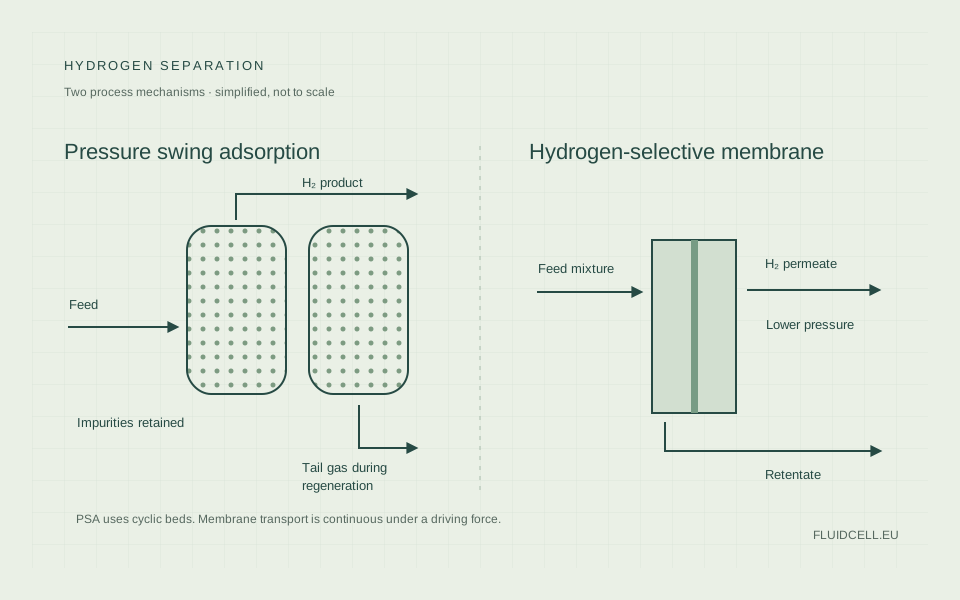
Compression equipment should be sized for actual inlet pressure and flow. A hydrogen-selective membrane may collect hydrogen at a lower pressure than a PSA product. Those differences can change the local supply chain even when both separators meet the same chemical specification.
Reliability includes more than one operating point
A site needs to decide what happens during planned maintenance, power interruption, a failed quality check or production-equipment downtime. Backup delivered gas can be an option, but it adds connections and operating procedures. Oversizing a production unit does not automatically cover a failure shared by its auxiliaries.
Maintenance access affects the value of a local system. A remote installation may reduce fuel delivery frequency while requiring specialist visits for a compressor, electrolyzer or reformer. Compare service intervals and spare-parts arrangements, not just annual fuel consumption.
Gas-quality assurance should cover startup and abnormal conditions. A separator's steady-state specification does not establish that every transient stream is suitable for a PEM stack. A diversion or shutdown strategy can prevent off-specification gas reaching the user.
Site integration and safe operation
Hydrogen-system design includes ventilation, leak detection, compatible materials and appropriate operating procedures. DOE's safety overview describes these as practical measures for controlling hydrogen hazards. 5
Local production requires a suitable site for equipment and storage. Process heat, oxygen from electrolysis, noise, maintenance access and electrical connections can influence layout. Local approval requirements should be checked for the actual installation; this guide is a system comparison, not a siting specification.
A combined heat and power system also needs a useful heat demand. If heat is available mainly when the building does not need it, a nominal combined efficiency can overstate usable performance. Report electricity and useful heat separately before adding them.
Compare supply routes on one boundary
For delivered hydrogen, include transport, storage, pressure regulation and site losses. For electrolysis, include water treatment, electrical conversion, gas conditioning, compression and storage. For reforming, include fuel preparation, heat, purification, carbon handling and the same downstream duties.
Use a common demand profile, quality specification, delivery pressure, availability target and emissions boundary. State utilization and energy-price assumptions. A comparison built on identical site requirements is more useful than one that assigns each technology its most favourable operating condition.
The hydrogen hub connects the supply chain to end uses. For the downstream conversion process, see PEM fuel cells explained.
Sources & further reading
- Hydrogen deliveryU.S. Department of Energy
- Hydrogen production: electrolysisU.S. Department of Energy
- Hydrogen production: natural gas reformingU.S. Department of Energy
- Hydrogen storageU.S. Department of Energy
- Safe use of hydrogenU.S. Department of Energy
- Di Marcoberardino et al. (2017). Achievements of European projects on membrane reactor for hydrogen productionJournal of Cleaner Production, 161, 1442–1450 · Design and simulation context for FERRET, FluidCELL and BIONICO; not final validation of the integrated FluidCELL system.