On this page
Pressure swing adsorption (PSA) separates hydrogen by retaining impurities in an adsorbent bed. A hydrogen-selective membrane separates it by allowing hydrogen to cross a barrier faster than other gases, or by a transport mechanism specific to hydrogen. Both can make useful hydrogen products, but their pressure, recovery and pretreatment requirements differ. 1
Begin with the feed composition and the downstream specification. A reformer gas containing carbon monoxide, carbon dioxide, steam and methane is a different separation problem from drying hydrogen made by electrolysis. The name of a separation technology cannot replace a gas-quality requirement.
How hydrogen PSA works
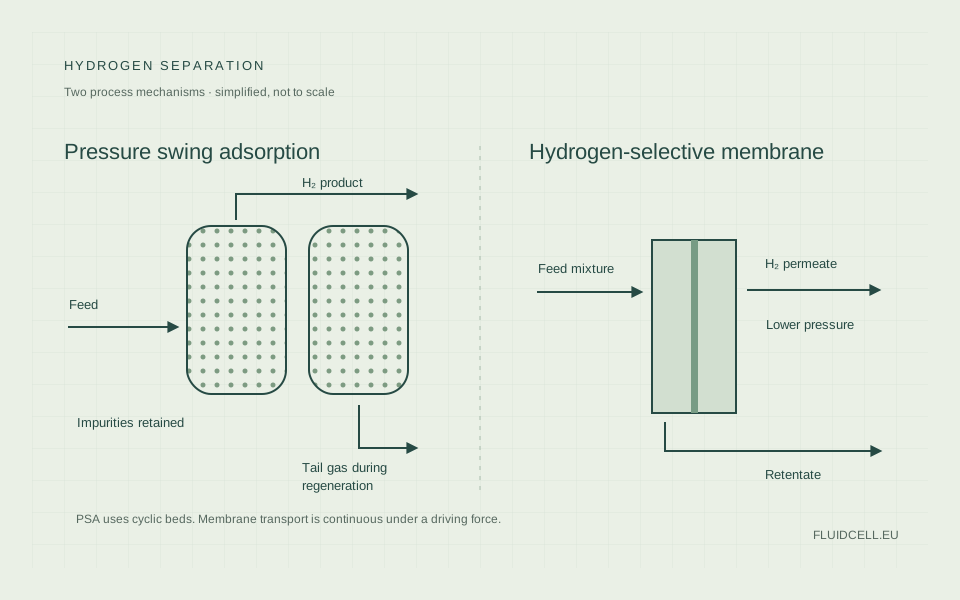
A compressed gas mixture passes through a bed containing adsorbents selected for the impurities. Those constituents adsorb more strongly than hydrogen, which leaves as the product. After the bed approaches its useful capacity, pressure is lowered and the retained gases are released.
A complete cycle normally includes adsorption, pressure equalization, depressurization, purge and repressurization. Multiple beds cycle out of phase to produce a continuous product stream. Valves and control timing are therefore part of the separation process, even though one bed works in stages. 1
The hydrogen product is obtained on the high-pressure side, allowing for bed and piping pressure losses. Some hydrogen leaves with the tail gas during regeneration. Tail gas can sometimes supply heat to a reformer, but its use and emissions need to be counted in the process balance.
Bed design depends on the impurity loading, adsorbent capacity, feed pressure and cycle. Changing the feed composition or required product flow can change breakthrough and recovery. A vendor's product-purity guarantee belongs to a specified operating envelope.
What "membrane separation" includes
Polymer gas-separation membranes transport gases through differences in solubility and diffusion. Porous inorganic materials separate through pore-dependent transport and interactions. Dense palladium-based membranes instead dissolve and transport hydrogen in atomic form.
These are different options. A polymer membrane used to enrich hydrogen from an industrial gas stream should not be assigned the selectivity of a defect-free palladium film. Palladium is suited to particular hot-gas applications and requires suitable materials, seals and contamination control. 2
For a hydrogen-selective pressure-driven membrane, hydrogen usually exits in the lower-pressure permeate stream. The retentate retains a portion of the hydrogen and most rejected species. The separation depends on hydrogen partial pressure across the membrane and on material behaviour in the actual mixture.
Some membrane systems retain hydrogen at pressure by preferentially removing another gas. The product side must therefore be stated explicitly. "Membrane product pressure" is meaningless without specifying which species crosses and which stream is used.
Compare purity and recovery separately
Purity describes the composition of the product. Recovery describes how much of the feed hydrogen is captured in that product. High purity does not establish high recovery.
For an illustrative molar-flow balance, suppose a feed contains 100 mol/h of hydrogen and the product carries 85 mol/h of hydrogen. Hydrogen recovery is 85%. If the product also contains 0.085 mol/h of impurities, its hydrogen fraction is approximately 99.90%. These values answer different questions and follow from assumed flows, not a measured commercial installation.
A membrane stage can increase recovery by collecting more permeate, but doing so changes local compositions and driving force. With membranes of finite selectivity, higher stage cut can lower product purity. Recycle and additional stages can improve the combination at the cost of complexity and possible recompression. 1
PSA also trades recovery against cycle conditions and product specification. Avoid comparing one system's best purity with another system's best recovery unless both values occur at the stated operating point.
Pressure can decide the preferred layout
PSA is attractive where a suitably compressed feed is available and the user wants hydrogen at a similar pressure. A hydrogen-selective membrane can be attractive for hot integration or compact recovery, but collecting a lower-pressure product may create a subsequent compressor duty.
A useful comparison asks for product pressure at the battery limit, after the separation package. If one quote excludes compression and another includes it, their energy consumption and price are not on the same basis.
Vacuum on the permeate side can support membrane transport. So can steam sweep, followed by condensation. Both change the flowsheet. A sweep containing a non-condensable gas introduces another separation or dilution issue. 2
Pressure ratio is not a complete description for dense palladium transport. Hydrogen partial pressures and the applicable permeation relation matter. The membrane-reactor engineering guide explains the square-root-pressure form used under diffusion-controlled conditions.
A practical comparison
| Design question | Hydrogen PSA | Hydrogen-selective pressure-driven membrane |
|---|---|---|
| Where does the desired hydrogen leave? | Mostly in the high-pressure product during adsorption | Usually in lower-pressure permeate |
| What provides selectivity? | Preferential adsorption of impurities | Material-specific permeation |
| What drives operation? | Adsorption pressure and regeneration cycle | Hydrogen chemical-potential or partial-pressure difference |
| What needs close attention? | Feed conditioning, impurity breakthrough and valve cycles | Feed conditioning, selectivity, seals and available driving force |
| How is recovery changed? | Bed configuration, cycle and purge strategy | Area, stage cut, pressure conditions, staging and recycle |
| How does hot-reactor integration fit? | Usually a separate downstream separation stage | Some inorganic membranes can be installed in the reaction zone |
The table describes process mechanisms, not a universal ranking. Electrochemical hydrogen separation is a further membrane-based option that uses an applied electrical potential and can combine separation with compression. It should be evaluated separately from a passive pressure-driven module. 1
Pretreatment protects the separator
Steam-reforming gas needs conditioning before many downstream purification systems. Cooling, condensate removal and feed cleanup should be included in the system description. DOE's conventional natural-gas reforming outline places purification after reforming and shift conversion. 4
Liquid carryover and contaminants can damage adsorbents or membrane modules. Palladium-based membranes are particularly sensitive to surface inhibition by some gases and to sulfur exposure. A claim about hydrogen selectivity in clean gas says nothing about tolerance of every industrial impurity. 2
Pretreatment is not automatically identical for PSA and membranes. Ask for acceptable water, sulfur, hydrocarbon and particulate levels for the actual product. A complete offer includes replacement intervals and what happens when the feed falls outside that envelope.
A purity percentage does not prove fuel-cell suitability
Two hydrogen streams can have the same total hydrogen percentage and different effects on a PEM fuel cell. Trace carbon monoxide and sulfur matter at concentrations that a bulk-purity measurement cannot characterize adequately.
The National Physical Laboratory's published hydrogen-quality material lists impurity-specific quantities and measurement methods. Its examples make clear why a certificate needs individual analytes and detection limits. 3
A project specification should identify the applicable current standard and the fuel-cell supplier's requirements. Use the hydrogen purity guide to distinguish a standard-based quality assessment from a generic percentage claim.
Economics belong to the complete supply system
Installed cost includes pretreatment, separator, compressor where needed, controls and integration. Operating cost includes energy, lost hydrogen, consumables, inspections and maintenance. A low separator power draw can coexist with a large external compression duty.
At small or intermittent demand, modularity and turndown can matter more than maximum design-point recovery. At steady larger flows, bed cycling, equipment utilization and tail-gas use affect the comparison. Hybrid arrangements can use a membrane for enrichment and PSA for final cleanup; they should be compared with the simpler alternatives on the same basis.
Request a mass balance with hydrogen and impurity flows, feed and product pressures, net power demand, operating range and a guaranteed quality envelope. Those data allow a useful comparison. A single purity figure or a claim of "low energy" does not.
Sources & further reading
- Recent Advances in Membrane-Based Electrochemical Hydrogen Separation: A Review (2021)Membranes, 11(2), 127 · Open access, CC BY 4.0. PSA, pressure-driven membranes and electrochemical separation.
- Alique et al. (2018). Review of Supported Pd-Based Membranes Preparation by Electroless Plating for Ultra-Pure Hydrogen ProductionMembranes, 8(1), 5 · Open access, CC BY 4.0. Thin films, supports, transport and failure mechanisms.
- Gas standards brochure (2023): hydrogen purityNational Physical Laboratory · Illustrative ISO 14687 impurity thresholds and traceable analytical methods. Use the applicable current standard for a procurement specification.
- Hydrogen production: natural gas reformingU.S. Department of Energy