On this page
PEM fuel cells need hydrogen with controlled impurities. A total hydrogen fraction such as 99.99% leaves the identity of the remaining gas unspecified. Carbon monoxide, sulfur compounds, water, nitrogen and other constituents affect a fuel cell in different ways, so one percentage cannot establish compatibility. 1
Hydrogen concentration in a process stream and compliance with a fuel-quality specification are different claims. A reformer can produce a hydrogen-rich gas that still needs extensive cleanup before it reaches a low-temperature PEM anode.
What a percentage leaves out
A gas that is 99.99% hydrogen contains a combined 0.01% of other constituents, or 100 μmol/mol. That number says nothing about how the remainder is divided between species. One stream might contain mostly nitrogen; another might contain carbon monoxide at a level that interferes with anode reactions.
In an illustrative mixture containing 10 μmol/mol of carbon monoxide and 90 μmol/mol of nitrogen, the total hydrogen fraction is still 99.99%. Changing the impurity split leaves the bulk fraction unchanged. It changes the fuel-cell problem.
Use amount fraction units consistently. One μmol/mol equals one part per million on a molar basis. One nmol/mol equals one part per billion on the same basis. Mass-based fractions cannot be substituted without accounting for molecular masses.
Purity can also be reported on a dry basis that excludes water. A certificate should state its basis and list water separately. The phrase "high-purity hydrogen" is not an analytical method or a specification.
Why carbon monoxide matters
A PEM anode catalyst provides sites for hydrogen oxidation. Carbon monoxide can occupy those sites and reduce the reaction rate. The response depends on catalyst composition, temperature, concentration and exposure history.
DOE lists sensitivity to fuel impurities among the limitations of polymer electrolyte fuel cells. Some higher-temperature or modified-catalyst systems have different tolerances, but a tolerance claim belongs to that system. It should not be transferred to every PEM stack. 3
The FluidCELL final report describes cell and stack work on contaminated reformate and the addition of a methanation step in its integration design to control carbon monoxide. It also reports difficulties maintaining the intended hydrogen quality during system tests. Those details explain why reactor selectivity and stack compatibility must be evaluated together. 5
Other impurities create different problems
Sulfur-containing species can interfere strongly with catalyst surfaces. Nitrogen and helium can dilute the fuel and accumulate in some anode arrangements, changing purge requirements and utilization. Oxygen, water and other constituents need limits appropriate to the system and fuel-quality standard.
A broad statement that "all impurities poison the catalyst" is inaccurate. Some mainly dilute hydrogen, some alter operating conditions, and some produce chemical damage. Identity, dose and exposure matter.
Sources of contamination can include production equipment, purification stages, compression, storage and sampling hardware. A quality assessment should therefore identify its sampling point. Testing at the production outlet does not automatically describe the gas at the final user's connection. 4
Use the current standard and the correct application
ISO 14687:2025 is the current second edition of Hydrogen fuel quality: Product specification. It replaces the 2019 edition. Its requirements must be applied to the relevant fuel application and category. A stationary installation should not copy a road-vehicle specification without checking its intended scope and the stack supplier's requirements. 2
The National Physical Laboratory's 2023 gas-standards brochure gives useful examples from the earlier standard context. It lists a carbon monoxide amount fraction of 0.2 μmol/mol and total sulfur compounds of 0.004 μmol/mol, among other analytes. These examples explain the need for trace measurements; they are not presented here as a complete 2025 procurement specification. 1
A current procurement document should name the standard edition, relevant application, sampling conditions, acceptance limits and supplier-specific requirements. Where a supplier specifies tighter limits or a different operating envelope, resolve that before commissioning.
Standards establish a specification. They do not prove that a particular gas sample meets it. That requires measurement and an appropriate quality-assurance process.
Measurement must reach the required scale
A sensor that measures bulk hydrogen fraction cannot normally characterize every trace contaminant of interest. Analytical methods may include gas chromatography and spectroscopic techniques, selected for the species and required range.
Detection limit, quantification limit and measurement uncertainty answer different questions. "Not detected" means the method did not detect the constituent under its stated conditions. It does not mean that the constituent is absent.
A method with a detection limit above an acceptance threshold cannot establish compliance with that threshold through a non-detection result. A useful certificate identifies the method, measured result or reporting limit, units, sample location and uncertainty where relevant.
NPL describes calibration gases and traceable analytical methods for hydrogen-quality measurements. The distinction between a traceable analyte measurement and a generic hydrogen-percentage reading is central to interpreting a certificate. 1
Sampling can change what is measured
Sampling equipment must preserve a representative gas sample. Surface interactions, moisture and contamination in tubing or containers can alter low-concentration measurements. Pressure changes and sample conditioning also need a defined method.
An analysis therefore needs context: where the sample was taken, how it was transferred, and whether the process was in steady operation. A sample taken after a filter does not establish the composition upstream; a sample after a storage stage can reveal a problem absent at the separator outlet.
Agree sampling and handling procedures with the analytical provider. The most sensitive instrument is of limited use if the sample it receives does not represent the fuel supplied to the stack.
Purification needs a contaminant-specific target
PSA, pressure-driven membranes and additional polishing stages remove different constituents under different conditions. A palladium membrane can be intrinsically highly selective for hydrogen while an installed module leaks other gases through a defect or seal. PSA performance depends on feed conditioning, adsorbents and its operating cycle. 4
The purification package should guarantee the required analyte limits across an agreed operating range. Include startup, turndown and what happens when the feed changes. A nominal recovery or a single steady-state purity measurement cannot describe all those conditions.
A methanation stage converts carbon monoxide into methane using hydrogen. It changes the gas composition and consumes some hydrogen; it does not turn every contaminant into acceptable fuel. Drying and other treatment may still be needed. The complete process should be assessed on the resulting stream specification. 5
The PSA and membrane comparison describes the separation trade-offs without treating one technology as a universal answer.
Laboratory tolerance is not a lifetime guarantee
A short controlled experiment can show how a cell responds to a particular impurity dose. It does not automatically establish acceptable exposure over years, under cycling, or in a larger stack with uneven gas and water distribution.
Test hardware designed to maintain uniform gas composition, humidity and temperature helps separate material behaviour from operating gradients. The 2023 zero-gradient hardware study explains why control of those conditions matters for durability comparisons. 6
Interpret contamination data with the test duration, catalyst, membrane, load and recovery procedure. A reversible short-term voltage loss and persistent material degradation are different outcomes. Both can matter operationally, but they should not be combined into one undifferentiated "tolerance" number.
What to request from a hydrogen supplier
Request an application-specific quality specification, a contaminant list with units and limits, and a certificate or measurement plan capable of testing those limits. State the pressure and location at which fuel is delivered. Identify how off-specification gas is isolated and how quality is checked after maintenance or supply changes.
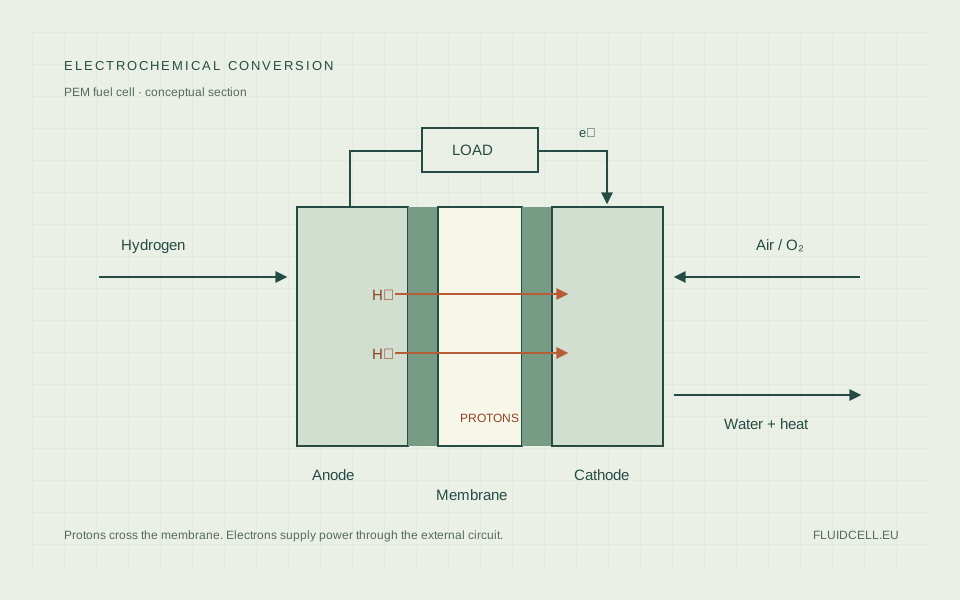
For a new installation, coordinate the hydrogen producer, purification supplier, analytical provider and stack supplier around that same specification. The fuel-cell fundamentals guide explains the electrochemical components that the specification protects.
Sources & further reading
- Gas standards brochure (2023): hydrogen purityNational Physical Laboratory · Illustrative ISO 14687 impurity thresholds and traceable analytical methods. Use the applicable current standard for a procurement specification.
- ISO 14687:2025: Hydrogen fuel quality — Product specificationInternational Organization for Standardization
- Types of fuel cellsU.S. Department of Energy
- Recent Advances in Membrane-Based Electrochemical Hydrogen Separation: A Review (2021)Membranes, 11(2), 127 · Open access, CC BY 4.0. PSA, pressure-driven membranes and electrochemical separation.
- FLUIDCELL: final report summaryEuropean Commission, CORDIS · Consortium-reported component tests, modelling and integration limitations.
- An open-source zero-gradient cell hardware to improve and accelerate durability testing of PEM fuel cells (2023)HardwareX · Controlled operating conditions and differences between cell tests and larger hardware.