On this page
Bioethanol can be converted into hydrogen by reacting ethanol with steam over a catalyst. The outlet is normally a mixture containing hydrogen, carbon dioxide, carbon monoxide, water and other products. Reforming and purification are separate tasks, even when a membrane reactor combines them in one vessel. 1
The prefix "bio" describes where the ethanol came from. It does not change ethanol's molecular chemistry or establish the emissions of the resulting hydrogen. Feedstock cultivation, processing energy and the reformer's heat supply all affect that assessment.
The overall reaction is a bookkeeping limit
The ideal overall steam-reforming reaction is:
C₂H₅OH + 3 H₂O ⇌ 2 CO₂ + 6 H₂
It balances carbon, oxygen and hydrogen atoms. Under that idealization, one mole of ethanol can yield six moles of hydrogen. This is a stoichiometric ceiling for complete conversion to carbon dioxide with steam, not a guarantee of a reactor's measured output.
Hydrogen comes from both ethanol and water. An illustrative mass balance makes this clear: approximately 46 g of ethanol and 54 g of water correspond to roughly 12 g of hydrogen and 88 g of carbon dioxide. Those rounded masses follow from the balanced equation; they are not plant performance data. Real operation uses additional steam and has competing reactions, losses and incomplete recovery.
The feed must be vaporized, the reaction needs heat, and the product gas must be conditioned. Counting hydrogen molecules without counting those duties gives an incomplete view of the process. The U.S. Department of Energy describes biomass-derived liquid reforming as a reforming step followed by shift conversion and hydrogen separation. 1
Ethanol follows several reaction pathways
Ethanol can dehydrogenate to acetaldehyde and hydrogen. It can dehydrate to ethylene and water. Carbon–carbon bond breaking, reforming of intermediate products, methane formation and the water–gas shift reaction compete as the gas contacts the catalyst.
The shift reaction is:
CO + H₂O ⇌ CO₂ + H₂
It increases hydrogen production while changing the carbon monoxide content. Ethylene and other intermediates can lead to carbon deposits. Methane can leave carbon and hydrogen in a product that has not been fully reformed. The observed product distribution therefore depends on catalyst composition, support, temperature and contact time. 3
Ethanol conversion alone is an insufficient performance measure. A reactor could convert essentially all ethanol into a mixture containing unwanted intermediates. A useful report includes hydrogen yield, carbon-containing products, carbon balance and catalyst stability.
Steam reforming and autothermal reforming
Steam reforming relies on heat supplied from outside the reacting mixture. In an autothermal arrangement, oxygen is also supplied so that oxidation reactions release heat inside the reactor. The oxygen-to-ethanol ratio influences temperature and how much feed energy remains available as hydrogen.
Autothermal does not mean energy-free. Some feed is oxidized to supply heat. Vaporization, startup and auxiliaries still have energy requirements. The system must balance heat generation with heat consumption across its operating range.
Excess steam can suppress carbon formation and affect the reaction equilibrium, but heating and vaporizing extra water adds a duty. A higher steam ratio can improve one reactor metric while reducing net system efficiency. Report whether the ratio is steam-to-ethanol or steam-to-carbon: ethanol contains two carbon atoms, so those numerical ratios are different.
The FluidCELL project investigated low-temperature autothermal ethanol reforming in a fluidized bed. Its component development and system-integration results are described in the final report. 5
What the catalyst has to do
A reforming catalyst must promote the desired reactions while limiting coke formation and surviving exposure to steam and repeated operation. Nickel is studied for reforming because it can catalyse the required chemistry, but stability and carbon deposition require attention. Noble-metal additions and oxide supports change activity and selectivity; they also affect manufacturing and cost.
A laboratory comparison by Miyamoto and colleagues used Ni/CeO₂ and Co/CeO₂ catalysts with a palladium–silver membrane. The comparison showed why catalyst selection belongs in the evaluation of the integrated reactor. A membrane cannot selectively remove hydrogen that the catalyst has failed to generate. 2
For a fluidized bed, chemical activity is only part of the specification. Particles need the appropriate size and mechanical strength to fluidize and resist attrition. Fine fragments can change bed behaviour and interact with membranes. Laboratory powder results do not establish the durability of a larger reactor using shaped or fluidizable particles. 4
How a membrane reactor changes the process
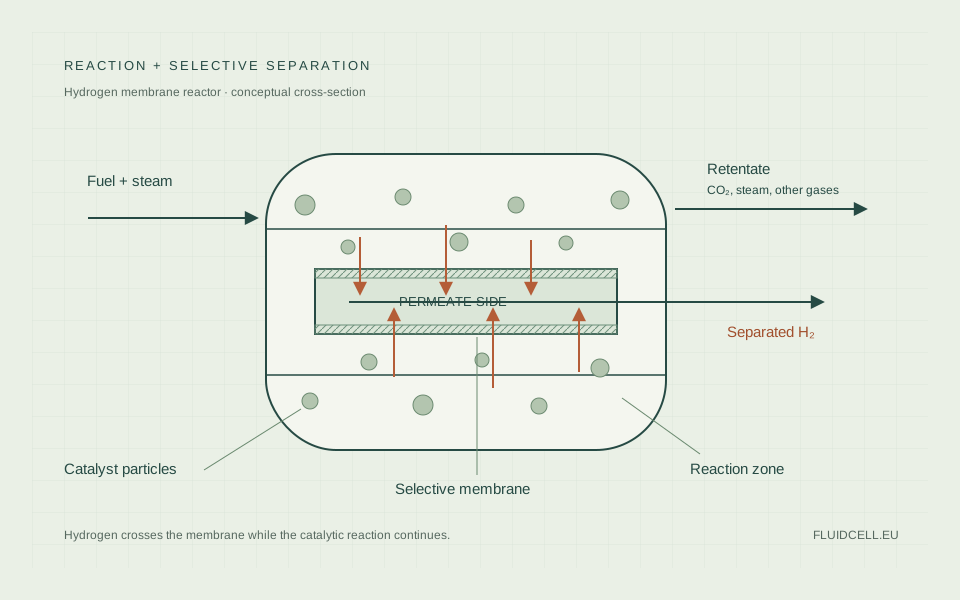
A hydrogen-selective membrane removes hydrogen while reforming proceeds. Product withdrawal can shift equilibrium and reduce the hydrogen concentration in the reacting gas. The separated permeate can then be cooled and conditioned for a downstream user.
Palladium-based membranes transport hydrogen through a dense metal layer. The pressure driving force depends on hydrogen partial pressure on each side, not simply on the total reactor pressure. Raising feed pressure, reducing permeate pressure or using a sweep stream can support hydrogen transport, with different consequences for equipment and energy consumption. 4
Selective removal can change competing reactions as well as overall conversion. The combination must be assessed for the actual catalyst and operating conditions. A membrane reactor does not remove the need to account for carbon in the retentate.
A defect-free selective film and a complete installed membrane module are also different things. Leaks around seals or through damaged layers allow other gases into the permeate. The resulting stream needs contaminant measurements before being fed to a PEM fuel cell.
Heat recovery determines useful efficiency
Hot retentate and other exhaust streams can supply heat to vaporize feed or preheat incoming gases. Recovering that heat reduces external demand only when the temperature levels and heat-exchanger arrangement permit it. Heat that cannot be used at the required temperature is not interchangeable with electrical power.
The efficiency boundary should include pumps, blowers, compressors and any vacuum system. If hydrogen is fed into a fuel cell, distinguish the fuel cell's efficiency on hydrogen from the complete system's electrical efficiency on ethanol. The reformer has already consumed or lost some of the original feed energy.
State whether fuel energy is measured using lower heating value (LHV) or higher heating value (HHV). HHV includes the condensation heat of product water. A given electrical output divided by HHV produces a lower efficiency percentage than the same output divided by LHV. Comparisons need one basis.
Bioethanol does not eliminate carbon emissions
The ideal reforming equation produces carbon dioxide. Biomass can have taken up carbon during growth, but that fact alone does not establish the complete emissions balance. Fertilizer production, land-use change, transport, ethanol distillation and process heat can contribute emissions.
A defensible assessment specifies the ethanol source and processing route, the energy used by the reformer, and treatment of co-products. Carbon capture, if proposed, requires its own separation, energy and storage assumptions. Separating hydrogen from carbon dioxide is not the same as capturing and permanently storing the carbon dioxide.
For local hydrogen supply, compare the complete ethanol route with delivered hydrogen or on-site electrolysis serving the same demand and product specification. Liquid-fuel handling can be convenient, but reformer startup, maintenance and quality control remain part of that comparison.
What a credible test campaign reports
The feed specification should include water content and possible denaturants or contaminants. Report temperature distribution, flow rates, pressure, steam ratio, oxygen ratio where applicable, hydrogen recovery and permeate quality. A stability test should state duration and whether it includes startup and shutdown cycles.
Keep equilibrium predictions, reactor experiments and complete fuel-cell-system tests separate. The FluidCELL final report describes reactor and stack work, but also reports that integration did not sustain the hydrogen flow and quality needed for the planned system analysis. That result should not be presented as successful validation of every design target. 5
The underlying separation options are compared in the hydrogen purification guide. For membrane sizing and pressure effects, continue with membrane reactors for hydrogen production.
Sources & further reading
- Hydrogen production: biomass-derived liquid reformingU.S. Department of Energy
- Miyamoto et al. (2016). Effects of Catalysts and Membranes on the Performance of Membrane Reactors in Steam Reforming of Ethanol at Moderate TemperatureProcesses, 4(2), 18 · Open access, CC BY 4.0. Comparison of Ni/CeO₂ and Co/CeO₂ with a Pd–Ag membrane.
- Iulianelli and Basile (2011). Hydrogen production from ethanol via inorganic membrane reactors technology: a reviewCatalysis Science & Technology
- Recent Advances in Pd-Based Membranes for Membrane Reactors (2017)Molecules, 22(1), 51 · Open access, CC BY 4.0. Membrane transport, reactor configurations and reforming research.
- FLUIDCELL: final report summaryEuropean Commission, CORDIS · Consortium-reported component tests, modelling and integration limitations.