On this page
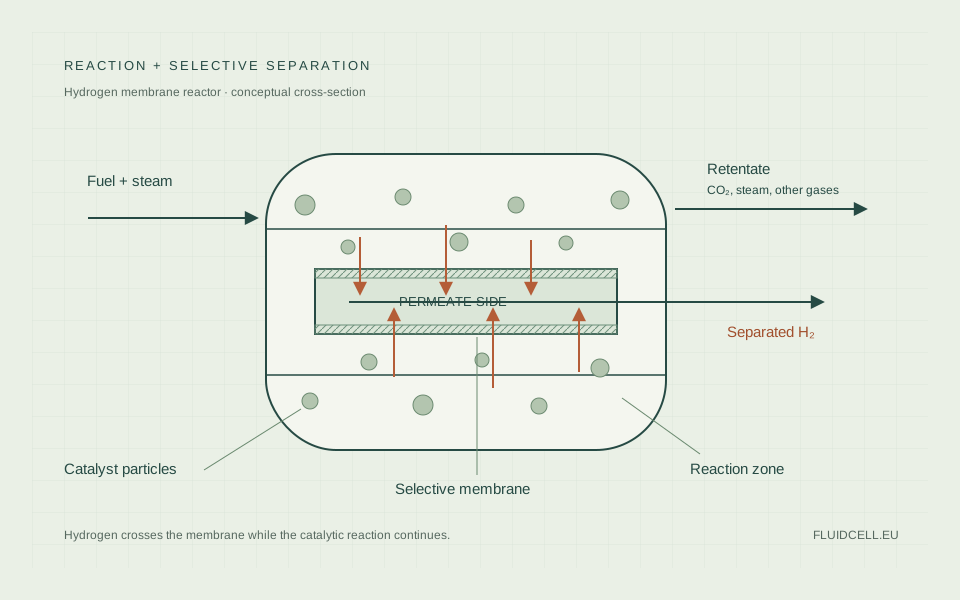
A membrane reactor carries out a chemical reaction and a selective separation in the same device. In a hydrogen-producing reactor, a catalyst converts a feedstock into a mixture of gases while a membrane removes hydrogen from the reaction zone. That removal changes the composition around the catalyst and can change how far the reaction proceeds. 1
The membrane does not make hydrogen by itself. The reaction makes it; the membrane provides a separate route out. This distinction explains both the appeal of the process and why a highly selective membrane alone does not guarantee a useful reactor.
What is being combined?
A conventional process can have a reactor followed by cooling, conditioning and separation equipment. A membrane reactor puts a selective barrier in contact with the reacting mixture. The gas that crosses the barrier is the permeate. The mixture left on the reaction side is the retentate. These terms describe streams, not whether either stream is useful or waste.
One common arrangement has catalyst packed around a membrane tube. Hydrogen passes through the tube wall and is collected inside it. Another suspends catalyst particles in an upward gas flow, producing a fluidized bed around the membranes. The membrane and catalyst can remain separate components; the selective material does not have to be the catalyst. 1
Membranes can also distribute a reactant into a reactor. An oxygen-transport membrane, for example, can supply oxygen along a reaction zone. Product removal and reactant dosing are different uses of the same general idea: control which species move between two regions.
Why removing a product changes conversion
Consider an equilibrium-limited reaction written schematically as A ⇌ B + H₂. In a closed reaction mixture at fixed temperature, the forward and reverse reactions eventually balance. Removing hydrogen changes the reaction quotient. The mixture can then produce more B and hydrogen before reaching equilibrium again.
This is the practical meaning of the equilibrium-shift argument often described using Le Chatelier's principle. A membrane reactor can exceed the conversion of a conventional reactor at the same temperature and comparable feed conditions because its reaction zone is an open system with selective product withdrawal. It does not invalidate thermodynamics. 2
The gain is conditional. The catalyst must make hydrogen quickly enough, hydrogen must reach the membrane, and the membrane must transport it at a useful rate. A slow reaction cannot be rescued by an enormous membrane area. A fast reaction cannot exploit product removal if the membrane is effectively blocked.
Some reactions are already close to complete conversion without a membrane. There, integration might simplify downstream purification or change product selectivity, but an equilibrium benefit should not be assumed. Compare the proposed reactor with the actual alternative process.
Membranes do not all separate in the same way
Dense palladium and palladium-alloy membranes transport hydrogen through a metal. Hydrogen molecules dissociate at the surface, hydrogen atoms dissolve and diffuse through the metal, and molecules form again on the other side. Other gas molecules do not follow that transport mechanism. A continuous, defect-free metal layer can therefore have extremely high hydrogen selectivity. A hole or a leaking seal bypasses that selectivity. 2
Porous inorganic membranes, including some silica and zeolite materials, separate gases through differences in pore transport, adsorption and molecular dimensions. Their performance depends on the pore structure and gas mixture. Calling every membrane a filter obscures these differences: dense metal membranes have no network of open pores through which intact hydrogen molecules are simply screened.
Polymer membranes generally rely on differences in how gases dissolve and diffuse in the material. They are used in gas separation, but a membrane suitable for a moderate-temperature separator is not automatically suitable inside a hot reformer. Temperature, steam exposure and chemical compatibility determine which materials can be used. 1
Mixed-conducting ceramic membranes are another class. They transport ionic and electronic species at elevated temperature. Their transport mechanism and required operating environment differ from both polymer gas-separation membranes and palladium membranes.
Where hydrogen applications fit
Steam reforming converts fuels and steam into hydrogen-containing gas. The water–gas shift reaction converts carbon monoxide and steam into carbon dioxide and more hydrogen. In either case, selectively withdrawing hydrogen can help an equilibrium-limited reaction proceed.
The important system boundary is wider than the reactor. Hydrogen production still requires feed preparation and energy. Retentate can contain steam, carbon dioxide, carbon monoxide and unconverted fuel. A membrane does not make those substances disappear. Their use, treatment or disposal remains part of the process.
Bioethanol reforming is especially relevant to the historical FluidCELL project. The project investigated an ethanol-fuelled membrane reformer coupled to a PEM fuel-cell system. Its purpose was to integrate hydrogen generation and separation, then use the product in a small combined heat and power installation. 4
A laboratory study by Miyamoto and colleagues compared catalyst formulations in an ethanol reforming membrane reactor. That kind of comparison matters because membrane separation and catalytic reaction must work together; replacing a membrane without considering the catalyst is an incomplete redesign. 3
What integration can improve
Removing hydrogen during reaction can increase conversion under specified conditions. It can also reduce the load on separate purification stages, and the extracted stream can have a much higher hydrogen concentration than the reactor outlet mixture.
A process might operate at a lower temperature for a required conversion, but the membrane itself has a temperature window. The catalyst also needs an appropriate temperature. Lower reactor temperature is therefore a design opportunity, not a universal property of membrane reactors.
Smaller equipment counts can be useful at distributed scale, where several separate cleanup vessels and heat exchangers add complexity. But fewer vessels do not prove lower installed cost. Membranes, supports, seals and monitoring can be expensive, and maintenance access becomes part of the reactor design. 1
The limits are often mechanical or transport-related
A high hydrogen flux measured with pure gas can fall in a reacting mixture. The mixture can inhibit the membrane surface, and hydrogen near the membrane can become depleted. The latter is a concentration-polarization or mass-transfer problem: the bulk gas composition overstates the concentration actually available at the surface.
Thin selective layers shorten the diffusion path and reduce precious-metal use. They also make defects and mechanical support more consequential. Porous supports carry pressure loads, but their own resistance can limit transport. Supports and coatings must tolerate thermal expansion without cracking or losing adhesion. 2
Sulfur-containing impurities can damage catalysts and inhibit palladium membranes. Repeated heating, cooling and pressure changes can challenge seals. A fluidized bed improves mixing and heat transfer, but particle contact can erode an exposed membrane surface. These are operating constraints, not details that can be left until after a high-flux material has been selected. 1
How to read a membrane-reactor result
A useful result specifies the feed composition, catalyst, temperature, reaction-side pressure, permeate conditions, membrane area and test duration. Conversion, hydrogen yield, hydrogen recovery and product purity answer different questions. They should be reported separately.
For example, complete ethanol conversion means ethanol disappeared from the feed. It does not establish that all possible hydrogen was produced, that most of it crossed the membrane, or that the separated stream meets a PEM fuel-cell quality specification.
Compare a membrane reactor with a conventional reactor on equivalent conditions and a declared energy boundary. An external vacuum pump, steam sweep or feed compressor can improve separation while consuming energy elsewhere. The engineering guide to hydrogen membrane reactors develops those pressure and integration choices in more detail.
Sources & further reading
- Recent Advances in Pd-Based Membranes for Membrane Reactors (2017)Molecules, 22(1), 51 · Open access, CC BY 4.0. Membrane transport, reactor configurations and reforming research.
- Alique et al. (2018). Review of Supported Pd-Based Membranes Preparation by Electroless Plating for Ultra-Pure Hydrogen ProductionMembranes, 8(1), 5 · Open access, CC BY 4.0. Thin films, supports, transport and failure mechanisms.
- Miyamoto et al. (2016). Effects of Catalysts and Membranes on the Performance of Membrane Reactors in Steam Reforming of Ethanol at Moderate TemperatureProcesses, 4(2), 18 · Open access, CC BY 4.0. Comparison of Ni/CeO₂ and Co/CeO₂ with a Pd–Ag membrane.
- Advanced m-CHP fuel cell system based on a novel bio-ethanol fluidized bed membrane reformerEindhoven University of Technology research portal